
THE AGRI-FOOD INDUSTRY: AN OVERVIEW OF TRENDS AND OUTLOOK
As the country’s second-largest industry after hydrocarbons, the agri-food sector occupies a strategic position in the Algerian economy. The sector accounts for nearly $14 billion in output value, comprises more than 47,000 businesses and employs around 1.6 million people. At the same time, new industrial capacity is emerging, technologies are advancing, and issues relating to local processing, quality, packaging and training are becoming increasingly important.
To analyse these developments, Djazagro has published its new white paper, "The agri-food industry: an overview of trends and outlook”. This overview is aimed at professionals who wish to better understand the transformations currently underway and identify the emerging prospects for the sector.
An overview of the agri-food industry in Algeria
With 47.4 million inhabitants by 2025 and food accounting for 34.3% of household expenditure, Algeria has a particularly significant domestic market for agri-food stakeholders. The sector’s development is also part of a broader ambition: to strengthen local production and processing, make better use of national agricultural resources and diversify the economy.
Agriculture, processing, ingredients, equipment, digitalisation, packaging, skills, exports… the Djazagro white paper analyses this entire value chain across seven main chapters, enriched with market data, expert insights and case studies of companies.
The agri-food sector at the heart of Algeria’s economic landscape
The first chapter provides an overview of the economic and agricultural landscape within which the Algerian agri-food industry operates.
With 43.98 million hectares of agricultural land, of which 8.6 million are under cultivation, Algeria possesses significant resources. From cereals, market gardening and arboriculture to livestock production and emerging sectors: production is diversifying, whilst major infrastructure projects are helping to reshape the country’s agricultural landscape.
This momentum is also driving an ambition to export, particularly to the European Union, Africa and Arab markets. In this regard, the development of the AfCFTA opens up new prospects for Algerian businesses.
Process more, create more value
Production is the first step; local processing enables us to go further in creating value. The agri-food industries account for around 40 per cent of industrial value added (excluding hydrocarbons) and employ a significant proportion of the manufacturing sector’s workforce.
Cereals, dairy products, beverages, biscuits, fruit and vegetables, cheeses, ingredients… the white paper explores several sectors that illustrate this rise in processing activity. It also looks at raw materials, flavourings and additives, and how local resources can become the starting point for new industrial applications.
Innovate, control, connect: new practices in the agri-food industry
Innovation is no longer limited to the finished product. It now encompasses the entire industrial infrastructure.
Energy efficiency, automation, Industry 4.0, artificial intelligence, the Internet of Things, predictive maintenance, digital traceability: manufacturers have new tools at their disposal to monitor their performance, reduce losses and better control their processes.
This development is accompanied by stricter requirements in terms of quality, nutrition and food safety. The white paper therefore examines controls, traceability, HACCP and the ISO 22000 standard, and how these are integrated into the day-to-day operations of agri-food businesses.

Packaging: a strategic link in the agri-food industry
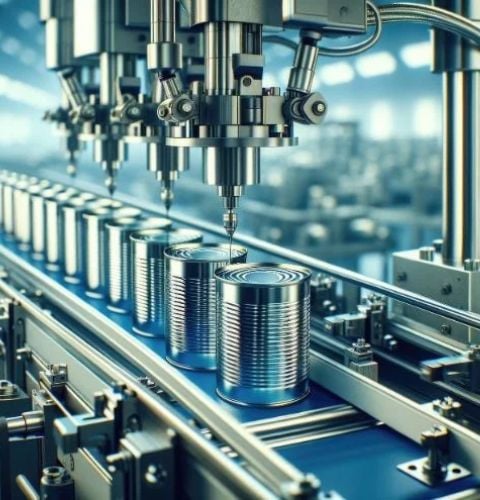
Packaging is no longer limited to protecting or containing a product: it is becoming a genuine driver of industrial performance, preservation, differentiation and access to new markets.
The Algerian agri-food packaging market is currently estimated at over 2 billion dollars, with expected annual growth of 6 to 7 per cent by the end of the decade. Cardboard, plastic films, labels, glass: several segments are gradually strengthening their local production capacities.
The white paper also analyses the opportunities offered by higher value-added packaging, the circular economy, packaging technologies and the digitalisation of equipment.
Buyers’ perspectives: the evolution of production systems
What, specifically, are Algerian manufacturers looking for when they invest?
Testimonials gathered from buyers highlight several priorities: optimising processes, reducing waste, improving quality, modernising equipment and increasing flexibility. Three perspectives from the drinks and cereal processing industries allow these key challenges to be compared with the needs on the ground.
Human capital: skills, knowledge transfer and the future of industry
The modernisation of the industry cannot take place without the skills to support it. Digitalisation, automation, quality, maintenance, food safety and innovation are giving rise to new requirements.
Universities, engineering schools, technical centres and vocational training institutions all play a part in shaping this ecosystem. A key challenge is to develop professionals capable of combining technical expertise, an understanding of markets and proficiency in digital tools.
In the longer term, closer links between education and industry, and the development of a genuine culture of innovation, appear to be key drivers of competitiveness for the sector.
Understanding Algeria’s agri-food sector today to prepare for tomorrow
Local processing, modernisation of equipment, innovation, quality, packaging, skills development and exports: the Algerian agri-food industry is scaling up.
This Djazagro white paper offers a cross-cutting perspective on these developments, drawing on data, concrete examples and testimonials from industry professionals.
Everything you need to know about our white paper
-
What role does the agri-food industry play in the Algerian economy?The agri-food sector is the country’s second-largest industry after hydrocarbons. The sector accounts for nearly 14 billion dollars in output value, comprises more than 47,000 businesses and employs around 1.6 million people.
-
What are the main trends in the Algerian agri-food industry?Among the major developments analysed in the white paper are the growth of local processing, the modernisation of equipment, Industry 4.0, improvements in food quality and safety, developments in packaging, skills development and expansion into international markets.
-
What are the key challenges facing agri-food packaging in Algeria?Packaging is becoming a strategic link in the value chain. Beyond product protection, the key challenges relate in particular to preservation, the performance of packaging lines, traceability, sustainability and the ability of Algerian products to meet the requirements of different markets. The Algerian agri-food packaging market is estimated to be worth over 2 billion dollars.
-
What does the Djazagro white paper on the agri-food industry in Algeria cover?The white paper provides an overview of the sector across seven chapters devoted to the Algerian economic and agricultural landscape, local processing, new industrial practices, packaging, buyer expectations, human capital and Djazagro’s role as an observatory monitoring changes in the Algerian agri-food sector. It combines market data, analyses, expert testimonies and real-world examples.